Dash Core v24

More of Dash,
directly in the wallet.

A look at what’s shipping, what we’re building next, and three workflows we can already put in front of users.

Announcement+Demo preview
Dash Core v2401 / 15
The problem

Dash can do a lot. Too much of it still feels like infrastructure.

RPC sequences copied keys raw addresses manual coordination
The protocol can stay sophisticated.

The wallet should make the job understandable.

Why v24 matters02 / 15
Today’s route

Three jobs the wallet should make easier.

01

Run

Register and maintain a regular masternode or EvoNode.

02

Share

Own collateral together without giving it to a custodian.

03

Pay

Find a person by name and let the wallet verify the rest.

Run · Share · Pay03 / 15
Demo status

The demo branch combines what has landed with what is still in review.

Merged

In the v24 train

Code that has landed in Dash Core’s develop branch.

Demo preview

Integrated end to end

Open work brought together so the complete workflow can be shown.

I’ll flag preview work before each demo.

Status as of 3 Sep 202604 / 15
Run

Masternode operation is now a wallet workflow.

Choose a regular masternode or EvoNode, review the roles and keys, then register and maintain it from Dash-Qt.

Merged

The same area also exposes service updates, registrar updates, and revocation.
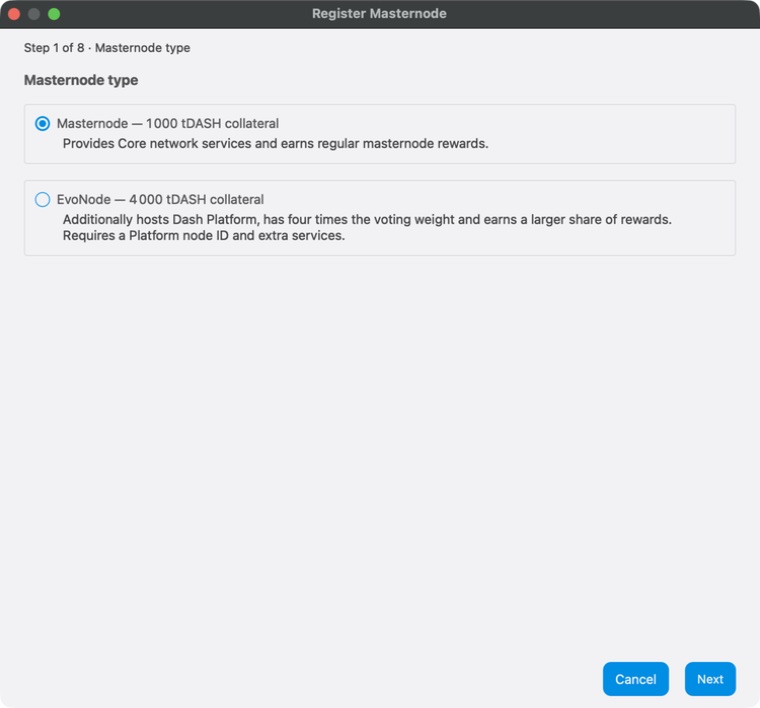
Dash Core Register Masternode dialog showing the regular masternode and EvoNode choices
Dash-Qt masternode tools05 / 15
Demo 01 · Run

Register a masternode.
Then maintain it.

Choose the node, review who controls what, and manage it later—all in Dash-Qt.

01 · Choose Regular or EvoNode Start with the role the node will perform.
02 · Review Roles and keys See who owns, operates, votes, and gets paid.
03 · Maintain One place in the wallet Update service, registrar details, or revoke.
Live in Dash-Qt06 / 15
Share

One masternode. Several owners. No custodian holding the collateral.

Two to eight wallets can fund one collateral together. Terms, signatures, rewards, refunds, and dissolution stay enforceable.

Demo preview

Coordination can be sequential or parallel; each participant signs only from their own wallet.
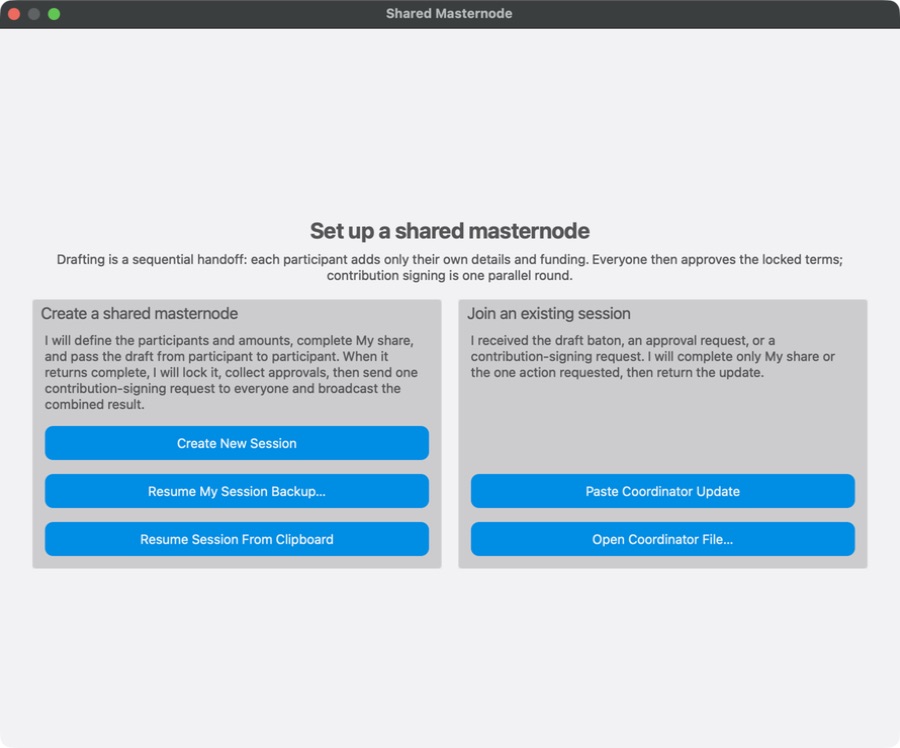
Dash Core dialog for creating or joining a shared masternode setup
Decentralized masternode shares07 / 15
Demo 02 · Share

Build one together.
Keep control.

Two wallets agree on the terms and sign independently; no private keys change hands.

01 · Agree Set the terms Contributions, roles, payouts, and exit rules.
02 · Sign Each wallet approves Every participant signs from their own wallet.
03 · Combine Broadcast one registration The collateral moves atomically—or not at all.
Live in two wallets08 / 15
Pay

A payment can start with a person, not an address.

Create a username, connect with someone, and let Dash Core resolve a fresh payment address from a verified relationship.

Demo preview

The client verifies Platform proofs; the lookup is not simply trusted because a server returned it.
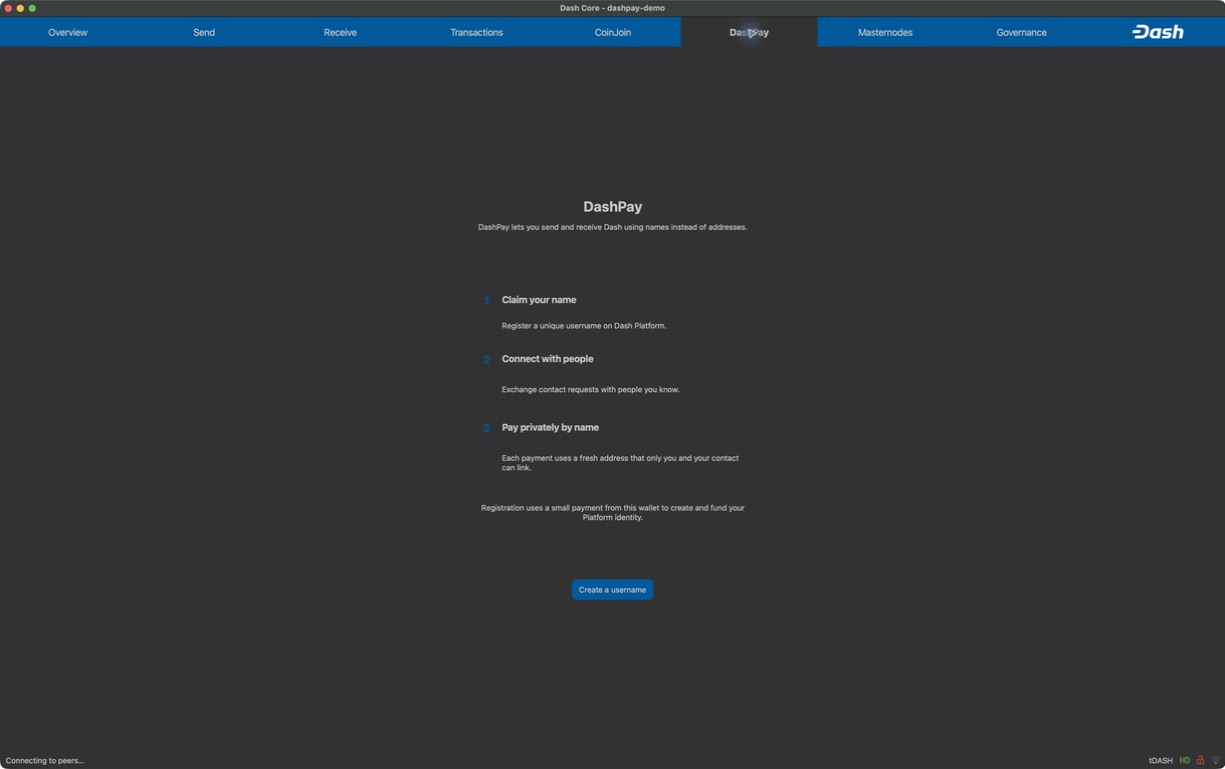

DashPay welcome screen in Dash Core with username, contacts, and private payment benefits
DashPay in Dash Core09 / 15
Demo 03 · Pay

Find the name.
Pay the person.

DashPay turns a verified contact into a normal Core payment.

01 · Identify Claim a username Create or recover the Platform identity.
02 · Connect Add the contact Verify the person and establish the relationship.
03 · Pay Send to a fresh address The wallet resolves it from the contact.
Live in Dash-Qt10 / 15
Under the interface

Convenience doesn’t replace verification.

Dash-Qt

Shows the decision, keeps the keys, and asks for explicit approval.

typed calls

Core wallet

Descriptors, transactions, roles, signatures.

Platform client

Identities, contacts, state proofs.

verify

Dash networks

Consensus enforces ownership and payments. Platform proofs authenticate returned state.

Clear trust boundaries11 / 15
Asset Unlock v2

Withdraw from Platform. Spend the DASH immediately.

A stable transaction ID lets InstantSend lock a spend before the Asset Unlock itself is mined.

01 · Platform

Withdrawal approved

A Platform quorum signs the Asset Unlock.

02 · Asset Unlock v2

One stable txid

Expiry and re-signing no longer invalidate a transaction spending its output.

03 · InstantSend

Spend straight away

The child transaction can receive InstantSend finality while the unlock is still unmined.

No confirmation wait before the withdrawn DASH is usable. In progress for v24
Platform → Core, without the wait12 / 15
AssumeUTXO

Use the node sooner. Verify every block in the background.

A known snapshot provides recent chainstate while a second chainstate validates the full history from genesis.

Start from a recent snapshot

Load the UTXO set together with the masternode, quorum, credit-pool, and activation state Dash needs at that height.

Become useful sooner

The active chainstate can catch up from the snapshot instead of replaying years of blocks first.

Replay the history

Background validation still starts at genesis and works forward block by block.

Require both states to agree

The snapshot is promoted only after its UTXO and Dash-specific state checks pass.

Foundations merged Snapshot load in progress
Faster startup, same verification13 / 15
Supporting work

The rest improves recovery, privacy, and Platform operations.

Wallet recovery
Merged

Descriptors by default

New wallets use descriptors; legacy wallets have a supported migration path.

Privacy
Merged

Better CoinJoin denomination handling

Adjacent denominations can be promoted or demoted, with tighter session accounting.

Platform wallets
Merged

Addresses, keys, and Asset Locks

Platform addresses, wallet key records, and Asset Lock v2 support the new wallet workflows.

The supporting release work14 / 15
Dash Core v24

More of Dash is becoming usable where people already are: the wallet.

RunMasternode tools · merged
ShareIndependent ownership · preview
PayVerified names and contacts · preview

The protocol still does the hard work. The user no longer has to do all of it by hand.

Thank you15 / 15